Sunday, February 6, 2011

February 5, 2011 Helping Veterans Trade Their Swords for Plows By


VALLEY CENTER, Calif. — On an organic farm here in avocado country, a group of young Marines, veterans and Army reservists listened intently to an old hand from the front lines.
“Think of it in military terms,” he told the young recruits, some just back from Iraq or Afghanistan. “It’s a matter of survival, an uphill battle. You have to think everything is against you and hope to stay alive.”
The battle in question was not the typical ground assault, but organic farming — how to identify beneficial insects, for instance, or to prevent stray frogs from clogging an irrigation system. It was Day 2 of a novel boot camp for veterans and active-duty military personnel, including Marines from nearby Camp Pendleton, who might be interested in new careers as farmers.
“In the military, grunts are the guys who get dirty, do the work and are generally underappreciated,” said Colin Archipley, a decorated Marine Corps infantry sergeant turned organic farmer, who developed the program with his wife, Karen, after his three tours in Iraq. “I think farmers are the same.”
At their farm, called Archi’s Acres, the sound of crickets and croaking frogs communes with the drone of choppers. The syllabus, approved by Camp Pendleton’s transition assistance program, includes hands-on planting and irrigating, lectures about “high-value niche markets” and production of a business plan that is assessed by food professionals and business professors.
Along with Combat Boots to Cowboy Boots, a new program for veterans at the University of Nebraska’s College of Technical Agriculture, and farming fellowships for wounded soldiers, the six-week course offered here is part of a nascent “veteran-centric” farming movement. Its goal is to bring the energy of young soldiers re-entering civilian life to the aging farm population of rural America. Half of all farmers are likely to retire in the next decade, according to the Agriculture Department.
“The military is not for the faint of heart, and farming isn’t either,” said Michael O’Gorman, an organic farmer who founded the nonprofit Farmer-Veteran Coalition, which supports sustainable-agriculture training. “There are eight times as many farmers over age 65 as under. There is a tremendous need for young farmers, and a big wave of young people inspired to go into the service who are coming home.”
About 45 percent of the military comes from rural communities, compared with one-sixth of the total population, according to the Carsey Institute at the University of New Hampshire. In 2009, the Agriculture Department began offering low-interest loans in its campaign to add 100,000 farmers to the nation’s ranks each year.
Among them will probably be Sgt. Matt Holzmann, 33, a Marine at Camp Pendleton who spent seven months in Afghanistan. He did counterinsurgency work and tried to introduce aquaponics, a self-replenishing agricultural system, to rural villages.
His zeal for aquaponics led him to the farming class. “It’s a national security issue,” he said the other day outside a garage-turned-classroom filled with boxes of Dr. Earth Kelp Meal. “The more responsibly we use water and energy, the greater it is for our country.”
Mr. O’Gorman, a pacifist and a pioneer of the baby-lettuce business, started the coalition after his son joined the Coast Guard. The group recently received a grant from the Bob Woodruff Foundation, co-founded by the ABC News journalist who was wounded in Iraq, to provide farming fellowships for wounded young veterans.
“Beginning farming has become the cause du jour among young people with college degrees and trust funds,” Mr. O’Gorman said at the farm, where there were stacks of Mother Earth News magazines in the bathroom and a batch of fresh kale in the sink. “My gut sense is a lot of them won’t be farming five years from now. But these vets will.”
Mr. Archipley’s own journey into organic farming was somewhat serendipitous. He joined the Marines in response to the Sept. 11 terrorist attacks and married between his second and third tours in Iraq. The couple bought three acres of avocado orchards north of San Diego.
Mr. Archipley, whose looks bring to mind a surfer dude, found pleasure tending his grove after leaving the Marines and eventually secured a loan from the Agriculture Department to build a greenhouse. His farm now sells organic produce to Whole Foods Markets in San Diego and Los Angeles.
In 2007, the couple started training veterans informally, financing the effort themselves. The new course, administered through MiraCosta College, costs $4,500, with Camp Pendleton offering assistance for active-duty Marines.
Farming offers veterans a chance to decompress, Mr. Archipley said, but, more important, provides a sense of purpose. “It allows them to be physically active, be part of a unit,” he said. “It gives them a mission statement — a responsibility to the consumer eating their food.”
Even in this idyllic setting, it can be a challenging process. Mike Nelson Hanes, now 34, enlisted in the Marines at 18. In 1994, six days into his basic training in South Carolina, his drill instructor committed suicide with an M-16 rifle in front of 59 recruits.
“He blew his head off,” Mr. Hanes said. “That was right from the get-go, at age 18.”
In Baghdad, Mr. Hanes served as a .50-caliber machine gunner atop a Humvee. “I was the one they were trying to kill,” he said. He returned home with post-traumatic stress disorder, depression and a traumatic brain injury. He was homeless for over a year, managing nevertheless to get a degree in environmental social services.
“Being outside was my comfort zone — still is,” he said. Two years ago, he stumbled upon the Archipleys’ “Veterans for Sustainable Agriculture” booth at an Earth Day festival in Balboa Park in San Diego. Mr. Hanes still struggles but is gaining ground.
“One thing I’ve noticed about agriculture is that you become a creator rather than a destroyer,” he said amid ornamental eucalyptus shrubs.
John Maki, Camp Pendleton’s transition assistance program specialist, said the life experiences of young veterans equip them for demanding work. “For a comparable age, you won’t find people who have had as much responsibility,” he said. “They’ve been tasked with making life-and-death decisions.”
Weldon Sleight, dean of the University of Nebraska’s College of Technical Agriculture, which has six enrolled veterans, said discipline — a mainstay of the armed forces — was critically important in agriculture. “A lot of these rural vets have this wonderful knowledge base about agriculture,” he added. “But we’ve told them for years there’s no future in it.”
In Central Florida, Adam Burke, who left farming to join the military, came full circle, designing a wheelchair-accessible farm in which his signature “red, white and blueberries” grow in containers on elevated beds.
Mr. Burke, a Purple Heart recipient who suffered a traumatic brain injury in Iraq, recently opened a second farm. “Squeezing a ball in physical therapy gets monotonous,” he said. “And you don’t get the mist from the sprinklers or a cool breeze in a psychologist’s office.”
Matthew McCue, 29, formerly Sergeant McCue, runs Shooting Star CSA outside San Francisco with his partner, Lily Schneider, delivering boxes of organic produce directly to consumers.
He recalled how orchard farmers in Iraq pridefully shared their pomegranates, tomatoes and melons.
“You learn how to face death,” he said of his service in Iraq. But in farming, he learned, “There was life all around.”

February 5, 2011 A Struggle to Disarm People Without Gun Rights By ED CONNOLLY and


By law, Roy Perez should not have had a gun three years ago when he shot his mother 16 times in their home in Baldwin Park, Calif., killing her, and then went next door and killed a woman and her 4-year-old daughter.
Mr. Perez, who pleaded guilty to three counts of murder and was sentenced last year to life in prison, had a history of mental health issues. As a result, even though in 2004 he legally bought the 9-millimeter Glock 26 handgun he used, at the time of the shootings his name was in a statewide law enforcement database as someone whose gun should be taken away, according to the authorities.
The case highlights a serious vulnerability when it comes to keeping guns out of the hands of the mentally unstable and others, not just in California but across the country.
In the wake of the Tucson shootings, much attention has been paid to various categories of people who are legally barred from buying handguns — those who have been “adjudicated as a mental defective,” have felony convictions, have committed domestic violence misdemeanors and so on. The focus has almost entirely been on gaps in the federal background check system that is supposed to deny guns to these prohibited buyers.
There is, however, another major blind spot in the system.
Tens of thousands of gun owners, like Mr. Perez, bought their weapons legally but under the law should no longer have them because of subsequent mental health or criminal issues. In Mr. Perez’s case, he had been held involuntarily by the authorities several times for psychiatric evaluation, which in California bars a person from possessing a gun for five years.
Policing these prohibitions is difficult, however, in most states. The authorities usually have to stumble upon the weapon in, say, a traffic stop or some other encounter, and run the person’s name through various record checks.
California is unique in the country, gun control advocates say, because of its computerized database, the Armed Prohibited Persons System. It was created, in part, to enable law enforcement officials to handle the issue pre-emptively, actively identifying people who legally bought handguns, or registered assault weapons, but are now prohibited from having them.
The list had 18,374 names on it as of the beginning of this month — 15 to 20 are added a day — swamping law enforcement’s ability to keep up. Some police departments admitted that they had not even tried.
The people currently in the database are believed to be in possession of 34,101 handguns and 1,590 assault weapons, said Steven Lindley, acting chief of the firearms bureau in the state’s Department of Justice. He estimated that 30 percent to 35 percent of the people on the list were there for mental health reasons.
Despite the enforcement challenges, the state’s database offers a window into how extensive the problem is likely to be across the country. Concrete figures on the scope of the issue are difficult to come by because no other state matches gun purchase records after the fact with criminal and mental health files as California does.
“There are 18,000 people on California’s list,” said Dr. Garen J. Wintemute, director of the Violence Prevention Research Program at the University of California, Davis, who helped law enforcement officials set up the system and is working on a proposal to evaluate its effectiveness. “So we can roughly extrapolate there are 180,000 such people across the country, just based on differences across populations.”
By way of context, Dr. Wintemute said that in 2009 only about 150,000 people were prevented from buying a gun because they failed background checks, out of about 10.8 million who applied.
Only a handful of states, however, even have the ability to keep track of handgun purchases the way California does, by either requiring a license or permit to own one or simply keeping records of such purchases. Even fewer require a license or permit for other types of firearms.
California’s system came about through a 2002 law that was even supported by the National Rifle Association, in part because it was billed as a way to protect members of law enforcement. It finally got under way in earnest in 2007. But though gun control advocates consider it a model, it still has serious gaps.
The system relies on records kept by the state on handgun purchases, but the state does not retain records of most rifle and shotgun purchases. There were 255,504 long guns sold in California in 2009 alone, compared with 228,368 handguns, according to state figures.
Perhaps most important, the burden for confiscating weapons falls largely on local jurisdictions, most of which are too short on resources to do much. Some may also have been only dimly aware of how the list works.
Police departments and sheriff’s offices that request access to the list of barred owners can log in to a secure account on the state Justice Department’s Web site and get monthly updates of who is on the list in their jurisdictions, with newly added names flagged. The Justice Department also trained more than 1,300 law enforcement officers around the state on the system in 2007 and plans another round this year.
It appears, however, that in the case of Mr. Perez, the Baldwin Park police were not checking the list at all in 2008, when the shootings occurred, in part because of confusion over how to access the database.
“Nobody knew where the e-mail was or where it was going,” said Lt. Joseph Cowan, head of detectives for the Baldwin Park Police Department.
Even today, Lieutenant Cowan acknowledged, his department rarely looks at the list, and he initially said he had no idea how many people in the city were on it. (He later checked and discovered there were about 35 people in his 6.6-square-mile district.)
“We try to get on,” he said. “But with staffing levels what they are, it’s difficult.”
A total of 37 police departments and three county sheriff’s offices in the state have not even signed up to get access to the database, despite receiving yearly notices, said Mr. Lindley, of the firearms bureau.
After being contacted by a reporter, two police departments — in East Palo Alto and Redwood City — said they had not subscribed to the database but would now do so, professing some confusion about the way the system functioned.
Capt. Chris Cesena of the Redwood City Police Department said he had been under the impression that state officials would call if anyone in Redwood City showed up on the list. Only after the department signed up recently did it discover there were 29 people in the city on the list, including seven for mental health reasons.
Detective Vic Brown, a supervisor in the Los Angeles Police Department gun unit, coordinates operations to disarm the roughly 2,700 city residents on the list.
“We just don’t have enough manpower to pursue every one of these cases,” he said. “These cases go on there quicker than we can get to them.”
It is no small task to conduct the necessary background work and knock on someone’s door, Detective Brown said. A case that seems relatively low-risk will usually involve four officers. If it is considered more dangerous, it might take eight. The priority, he said, is on people newly added to the system, because they are more likely to be at the address listed.
The state Justice Department’s firearms bureau does have a small unit, with 20 agents, that tracks down people on the list. Last year, it investigated 1,717 people and seized 1,224 firearms.
The list is growing far faster, however, than names are being removed. “We’re just not a very big bureau,” Mr. Lindley said. “We do the best we can with the personnel that we have.”
The bureau is planning a sweep this spring focused on people on the list for mental health reasons. Last summer, a man from the Fresno area who had recently been released from a mental health facility was found to possess 73 guns, including 17 unregistered assault rifles.
In the case of Mr. Perez, Lieutenant Cowan, of Baldwin Park, said he learned that state agents had been scheduled to visit Mr. Perez to confiscate his weapon — two weeks after the rampage took place.

FEBRUARY 5, 2011, 5:04 PM INVESTMENT BANKING Stock-Hedging Lets Bankers Skirt Efforts to Overhaul Pay BY


Intent on fixing a banking system that contributed heavily to the recent financial crisis, lawmakers and regulators pushed Wall Street to overhaul its pay practices. Big banks responded by shifting more compensation into stock, a move intended to align employees’ interests more closely with those of investors and discourage excessive risk-taking.
But it turns out that executives have a way to get around those best-laid plans. Using complex investment transactions, they can limit the downside on their holdings, or even profit, as other shareholders are suffering.
More than a quarter of Goldman Sachs’s partners, a highly influential group of around 475 top executives, used these hedging strategies from July 2007 through November 2010, according to a New York Times analysis of regulatory filings. The arrangements were intended to protect their personal portfolios when the firm’s stock was highly volatile, especially at the height of the crisis.
In some cases, executives saved millions of dollars by using these tactics. One prominent Goldman investment banker avoided more than $7 million in losses over a four-month period.
Such transactions are at the center of a debate over whether Wall Street executives should be allowed to hedge their stock holdings. The concern with hedging is that executives can easily break the ties between compensation and company performance. Employees who hedge their holdings are less concerned about a falling share price. That’s why the government barred top executives at banks that received multiple bailouts from using the strategies until they paid back the funds.

“Many of these hedging activities can create situations when the executives’ interests run counter to the company,” said Patrick McGurn, a governance adviser at RiskMetrics, which advises investors. “I think a lot of people feel this doesn’t have a place in a compensation structure.”
More broadly, critics say, the practice of hedging represents another end run around financial reform.
For example, new rules that cracked down on debit card fees have led several big banks to eliminate free checking. Firms also plan to make up missing revenue by adapting their businesses to the tougher new regulations on derivatives and trading with the banks’ own capital.
“Wall Street is saying it is reforming itself by granting stock to executives and exposing them to the long-term risk of that investment,” said Lynn E. Turner, a former chief accountant at the Securities and Exchange Commission. “Hedging the risk can substantially undo that reform.”
Most public companies, including Wall Street firms, have policies that ban the practice for only their most senior executives, though the number of executives affected varies by company.
At The New York Times, executive officers and other employees who have access to material nonpublic information about the company may not engage in hedging without written approval — a group that includes more than 100 people, as well as anyone they supervise.
Shareholders can figure out the investment practices of the highest-ranking officers of a public company, who are required by law to report. Even those disclosures are buried deep in the footnotes of regulatory filings. Whether lower-level executives are hedging is nearly impossible to determine.
But the unusual structure of the Goldman partnership requires the company to disclose the investment activities of partners in filings. The documents provide a window into what a broad range of senior executives were doing with their own shares.
Hedging — a commonly used tactic for years, especially during times of weakness or volatility — makes sense for executives at public companies who have amassed a large concentration of stock. They allow employees to limit losses, raise cash, or diversify their portfolios without selling the underlying holdings. Any individual investor can use hedging tactics for the same reasons, but few do because the transactions are complicated and make more sense for those who own a large amount of stock.
“Goldman Sachs shares represent the largest component of the wealth for many of our employees,” said Michael Duvally, a Goldman spokesman. “Hedging or outright sales, when allowed, can be a prudent part of a portfolio diversification strategy.”
By maintaining their stake, executives can continue to vote on shareholder proposals that influence the direction of the business. Hedging also helps investors to avoid the tax obligations associated with offloading stock.
There are various types of hedging strategies, many of which involve stock options. In one transaction, known as a covered call, a long-term shareholder can make income off a stock for a few months, provided it stays below a certain level. But if the price soars, the investor will not benefit from most of the rise.
In another hedge, known as a collar, an investor uses options to lock in the potential profits and losses on a stock. Although the move caps the potential upside, it also limits the risk.
Institutional hedging policies vary across Wall Street. Bank of America bans all employees from hedging their company stock, although management can make exceptions for “legitimate, nonspeculative purposes.”
But most big banks — including JPMorgan ChaseMorgan Stanley and Goldman Sachs — prohibit only their highest-ranking executives from such transactions. At Goldman, the chief executive, Lloyd C. Blankfein, and nine other top officers are not permitted to hedge their holdings, Mr. Duvally said.
The rest of Goldman’s employees can hedge shares they own outright. But they can’t make such moves with restricted stock. The partners, some of whom shape the firm’s strategy as heads of major business units, are required to hold 25 percent of their equity awards and are not allowed to hedge that portion of their holdings.
“Our equity awards vest over a multi-year period, are subject to clawbacks and cannot be hedged until they are delivered to our employees,” Mr. Duvally said. “These policies align equity compensation with the firm’s performance.”
The filings illustrate how routinely Goldman’s executives used the strategies. From July 2007 through November 2010, at least 135 partners used options to protect themselves from stock drops or to profit if shares held steady.
Several used such transactions routinely. Among them: David J. Greenwald, Goldman’s deputy general counsel overseeing its international businesses; Peter C. Aberg, a senior executive in the mortgage group; and Jack Levy, co-chairman of mergers and acquisitions. Howard Wietschner, the co-head of a hedge fund advisory group, had at least 32 such arrangements.
Shareholders over the same period endured roller coaster volatility. Goldman shares peaked at $248 in fall 2007 before dropping to $52 a year later after Lehman Brothers failed. At $164.83 on Friday, the stock still has not reached its former highs.
Regulators are taking a hard look at the practices. The Financial Stability Board, a group of global banking supervisors, wants firms to restrict employees from using the strategies. The Federal Reserve is examining hedging in its review of bank compensation.
And the Federal Deposit Insurance Corporation is expected to propose on Monday a new rule requiring big banks to defer at least 50 percent of annual stock and cash bonuses. That compensation would be released over the course of three years, so that executives don’t reap big, short-term windfalls even if their bets don’t pan out.
As part of the Dodd-Frank financial reform bill, the S.E.C. is hashing out regulations that would require all public companies to disclose their policies. Congress inserted the rule in the bill to discourage executives from hedging. The final S.E.C. proposal is anticipated during the second half of 2011.
For Goldman partners, the most popular hedging strategy was covered calls. Take Christopher Cole, chairman of Goldman’s investment bank and a member of the management committee. From 2007 to 2009, he made at least 11 such transactions, earning more than $675,000, according to the filings.
Not all strategies proved successful. With the stock around $98 in early February 2009, Milton R. Berlinski, who oversees a group that caters to private equity firms, made a risky bet called a short strangle. The maneuver would pay off if the stock stayed between $60 and $110 over the next six months. By mid-July 2009, Goldman shares were trading north of $156, meaning Mr. Berlinski took a loss.
Byron D. Trott, a Goldman partner best known as Warren E. Buffett’s investment banker, fared much better on one deal. In October 2008, Mr. Trott hedged 175,000 shares, using a collar to limit his profit potential but insulate him should the stock plummet over the next four months.
The transactions, set up months before, were executed just a few weeks after Mr. Buffett agreed to hand over $5 billion to Goldman in exchange for a potentially lucrative stake — a transaction Goldman hailed as a “strong validation of our client franchise and future prospects.” Mr. Trott, who did not return calls for comment, helped facilitate the investment. Goldman’s stock, which was trading around $128 that October, dropped to $73 by January. With the hedge, Mr. Trott lost roughly $2 million on the stake, less than a quarter of what he would have otherwise.
Two months later, Mr. Trott departed Goldman to start his own advisory firm.

READERS' COMMENTS


More than a quarter of Goldman Sachs's partners hedged their stock from 2007 to 2010, fueling concerns that executives have broken the ties between compensation and company performance.
Share your thoughts.

FEBRUARY 5, 2011, 5:00 PM Mark Twain and the Fortune-Teller By ADAM GOODHEART Disunion follows the Civil War as it unfolded. Tags: abraham lincoln, Blacks,mark twain, New Orleans, Samuel Clemens, Slavery, the civil war Cairo, Ill., Feb. 6, 1861


Library of Congress Mark Twain, circa 1867.
At the age of 25, Sam Clemens had every reason to feel pleased with himself. He was already one of the “aristocrats of the river” – a Mississippi steamboat pilot earning the princely sum of $250 a month. His job gave him the leisure to continue his process of self-education during slow stretches aboard, as he dipped into the works of Darwin and Macaulay, Suetonius and Shakespeare. The income gave him the wherewithal to live like a prince: in the finest New Orleans restaurants, the youth from Hannibal, Mo. dined on shrimp and oysters, washed them down with good brandy, smoked the very best cigars, and bought his brother Orion a splendid $12 pair of alligator-skin boots.
On this particular day, he had just finished a voyage aboard the side-wheeler steamboat Alonzo Child, bringing her safely 500 miles upriver from New Orleans. But apparently his mind still dwelt upon something that happened just before his departure. When he sat down to write Orion a long letter, he said nothing about the journey, but a great deal about a curious encounter in the Crescent City a week or two earlier: a visit to a psychic.

That Feb. 6, 1861 letter is one of few detailed ones to survive from a pivotal time in Sam Clemens’s life. It casts a strange – perhaps even unearthly – light on the complicated young man who would soon be Mark Twain.
He had known about the fortune-teller for a long time; the only reason he finally went to see her – as he assured his brother, a bit too emphatically to be wholly convincing – was that he was bored. Madame Caprell’s advertisements and handbills, which she distributed liberally throughout New Orleans, touted her gifts as a “clairvoyant” and “seeress.”
Library of CongressAdvertisement for Madame Caprelle, New Orleans Daily Picayune, May 3, 1861. CLICK TO ENLARGE
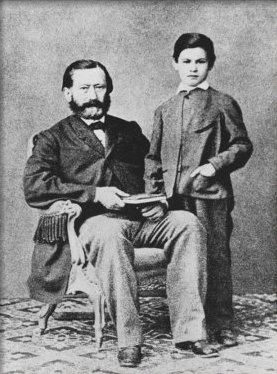
More unusually, the ads also called her a “spiritual physician” who “locates all invisible diseases, and prescribes the proper remedies therefor.” Her gifts, she assured the public, were not supernatural, but scientific. One suspects that later generations might have had a different term for her profession. (In distant Vienna, a lad named Sigismund Schlomo Freud was not yet five years old.)
Madame Caprell’s fee was $2; her address, 37 Conti Street. Perhaps Clemens was nervous; he rang the wrong doorbell. Then he found the right one – and a few moments later, he told Orion, “stood in the Awful Presence”:
She is a very pleasant little lady – rather pretty – about 28 – say 5 feet 2 ¼ – would weigh 116 – has black eyes and hair – is polite and intelligent – uses good language, and talks much faster than I do.
She invited me into the little back parlor, closed the door; and we were – alone. We sat down facing each other. Then she asked my age. And then she put her hand before her eyes a moment, and commenced talking as if she had a good deal to say, and not much time to say it in.
The conversation that followed made such an impression on Clemens that he wrote it all down almost word for word. In classic fashion, Madame Caprell began with a few easy hits. “You gain your livelihood on the water,” she said – as must have been obvious from the young man’s attire and his upriver accent. “You use entirely too much tobacco” – perhaps his breath told her this. She continued on a more flattering note: “There is more unswerving strength of will, & set purpose, and determination and energy in you than in all the balance of your family put together” – exactly what any precociously successful twenty-something would want to hear.
Scientifically based though they may have been, Madame Caprell’s prophecies were far from infallible. She told her client that he would marry twice. (He only married once.) She said he would have 10 children, a forecast that made him recoil in mock horror: “You must think I am fond of children.” “And you are,” she replied, although you pretend the contrary.” (She was right, but he would have only four.) She said he would die at the age of 28, 31, 34, 47 or 65 – or possibly 86, but only if he quit smoking. (He never did, and died of heart failure and respiratory disease at 74.) In at least one prediction, however, the seeress was eerily prescient. “You have written a great deal,” she said, “you write well – but you are rather out of practice; no matter – you will be in practice some day.”
In fact, although he did not know it yet, Sam Clemens stood on the brink of great life changes as 1861 began – changes that probably would never have come to pass without the Civil War. As the Union fell to pieces around him, he seemed to have no strong views on the matter one way or the other. On Jan. 26, the day that Louisiana seceded, he wrote in his journal only: “Great rejoicing. Flags, Dixie, soldiers.” Like many border-state Missourians at the start of the war, he vacillated. On one occasion, he distributed pro-secession cockades to a group of boys parading behind the Confederate flag. But shortly afterward, when he saw some other youths preparing to burn the Stars and Stripes, he rushed in to save it.
His views on slavery were similarly conventional. On the surface, at least, the young Clemens was a typical man of his place and time. He railed against “the infernal abolitionists” (even after Orion declared himself one). On a visit to New York, described the “mulattoes, quadroons, Chinese,” blacks and poor whites as a “mass of human vermin.” (He referred to the blacks using an epithet for which he remains controversial.)
Related Civil War Timeline
An unfolding history of the Civil War with photos and articles from the Times archive and ongoing commentary from Disunion contributors.
In later years, as Mark Twain, he would profess to have harbored deep doubts. He would recount an episode when, as a boy in Hannibal, he was horrified to see a white man “throw a lump of iron-ore at a slave-man in anger, for merely doing something awkwardly – he was dead in an hour.” On another occasion, he wrote he saw “a dozen black men and women chained to one another … awaiting shipment to the Southern slave market.” The incident, Twain implied, had shocked him. (The story is oddly similar to one that Abraham Lincoln told, about seeing 12 chained slaves on a steamboat “strung together precisely like so many fish on a trot line.”)
Yet these were all stories that he told only long after the war – at a time when he had befriended Frederick Douglass, put several black students through Yale Law School, and emerged as one of the nation’s fiercest white opponents of lynching. And something about them rings hollow. Although he professed shock at once seeing slaves chained together, this was something he would have witnessed almost daily along the New Orleans wharves, where the slave trade was conducted on a massive scale.
This is not to say that the young riverboat pilot’s inner moral qualms were not real. But one suspects that in his days on the Mississippi, he cruised a bit too easily between North and South, between free states and slave ones. As it would be for Huck and Jim, the river was his escape route – but in a different, and perhaps less flattering, sense.
All that would change very suddenly, not long after his visit to Madame Caprell. In May 1861, while Clemens was traveling up the Mississippi aboard the steamer Nebraska, a Union artillery battery blockading the river fired a warning shot across her bow. When the vessel failed to stop, a second shot smashed through her smokestack. The Nebraska was the last steamship to attempt such a voyage until the war’s end. The Mississippi River that Sam Clemens had known suddenly existed no longer.
Not even the fortune-teller could have fully predicted what came next. After a brief, unhappy stint as a Confederate soldier, Clemens left his old life behind and lit out for the territories, following Orion to Nevada. Instead of a Northerner or Southerner, he became a Westerner. Instead of a riverboat pilot, he became a writer. And instead of Sam Clemens, he became Mark Twain.
Sources: Edgar Marquess Branch et al., eds, “The Mark Twain Papers: Mark Twain’s Letters, Vol. 1, 1853-1866”; Mark Twain, “Life on the Mississippi”; New Orleans Daily Picayune, April 16, 1859, May 3 and 11, 1861; Ron Powers, “Mark Twain: A Life”; Arthur G. Pettit, “”Mark Twain and the South”; David Herbert Donald, “Lincoln”; Fred Kaplan, “The Singular Mark Twain”; Jerome Loving, “Mark Twain: The Adventures of Samuel L. Clemens”; Harriet Elinor Smith, ed., “Autobiography of Mark Twain, Vol. 1″; Joe B. Fulton, “The Reconstruction of Mark Twain: How a Confederate Bushwhacker Became the Lincoln of Our Literature.”
Adam Goodheart is the author of the forthcoming book “1861: The Civil War Awakening.” He lives in Washington, D.C., and on the Eastern Shore of Maryland, where he is the Hodson Trust-Griswold Director of Washington College’s C.V. Starr Center for the Study of the American Experience.

FEBRUARY 5, 2011, 7:00 PM The Strange Victory of the Palmetto State By MANISHA SINHA


Disunion follows the Civil War as it unfolded.
Less than two months separated South Carolina’s decision to secede from the United States and the creation of a new country, the Confederate States of America. In that time six other states, comprising the entire Deep South — Mississippi, Florida, Alabama, Georgia, Louisiana and Texas — had followed.
While each state had its share of secessionist fire-eaters, observers on all sides laid the blame firmly at the feet of the Palmetto State. Reverend R.J. Breckinridge of Kentucky, the pro-Union uncle of the southern rights Democratic candidate in the 1860 presidential elections, blamed secession fever on “the chronic hatred of South Carolina to the national Union.” Edmund Ruffin, an ardent Virginia secessionist, argued that it was natural for South Carolina to lead the secession movement because “the people of S.Ca. have been schooled and in training for 30 years in their political doctrines.” Republican party newspapers like the New York Times went so far as to call the seceded Lower South states the “Calhoun states” of America.
Library of Congress John C. Calhoun, the father of South Carolina’s secession movement.
Though actual secession occurred quickly, South Carolinian leaders had indeed been pushing the idea for decades, without success. Criticized widely for its political distemper throughout the antebellum period, South Carolina remained immune to the charms of Jacksonian democracy and guided by the stern proslavery constitutional logic of John C. Calhoun. The state had gone to the brink in the 1830s, but the rest of the South held back; regional unity proved too thin to justify swift action. That changed over the next three decades, though — and in 1861, after nearly 30 years of resisting the siren call of secession from South Carolina, the cotton states followed its lead. What had changed?
Above all was a new sense of regional unity. When South Carolina seceded, emissaries from Alabama and Mississippi were on hand to commend the decision. There was also an element of strategy: immediately after it seceded, South Carolina sent secession commissioners to the other Lower South states, urging disunion. It cleverly assigned fire-eating secessionists like Leonidas W. Spratt, father of the southern movement to reopen the African slave trade; A.P. Calhoun, the son of John C. Calhoun; and Milledge Luke Bonham, later replaced by fellow Congressman Armistead Burt, to the more radicalized states of Florida, Alabama and Mississippi. But it sent the more moderate, Democratic politicians James L. Orr and John L. Manning to Georgia and Louisiana, respectively, where Unionist sentiment still ran high. Many of these men had either lived in the states they were sent to or like, Manning and Calhoun, owned plantations there.
The Carolinian commissioners urged the speedy creation of a southern nation and conveyed a united message in their speeches to the secession conventions of the cotton states. The North and the Republicans stood for “the social principle that equality is the right of man,” according to Spratt, but the slave South embodied the “social principle that equality is not the right of man, but the right of equals only.” Similarly, John McQueen, the state’s commissioner to Texas, argued that the “policy” of the “Black Republicans” was “the elevation of our own slaves to an equality with ourselves and our children.”
Library of CongressThe Confederate leaders are portrayed as a band of competing opportunists led by South Carolina governor and secessionist Francis Pickens. CLICK TO ENLARGE.
As in South Carolina, most of these conventions were elected with large secessionist majorities. Only in Texas was the decision to secede was ratified post facto in a statewide referendum. Following South Carolina’s prompting, representatives of the seceded states met in Montgomery, Ala. on Feb. 4, and they adopted a provisional constitution that explicitly recognized racial slavery on Feb. 8.
Another factor contributing to regional unity under South Carolina’s leadership was the changing nature of North-South politics. A faction of South Carolinian planter-politicians had been crying secession at least since the Nullification Crisis of 1828 to 1832. Under Calhoun’s political tutelage, they argued that tariff laws formed a precedent for the federal government to interfere with the South’s “domestick institution” of slavery, and threatened to leave the Union unless they were allowed to “nullify” federal laws within the state.
But the rest of the South wasn’t convinced the Union was a bad deal for the region. After all, the long national ascendance of Virginia’s revolutionary dynasty of Washington, Jefferson, Madison and Monroe, as well as the resounding victory of Tennessee’s Andrew Jackson in the 1828 presidential election, showed the South could exert significant power over national affairs. Moreover, Jackson’s presence in the White House during the Nullification Crisis pulled many Southern states into the Unionist orbit and away from South Carolina.
Change was already afoot, however. With the rise of the abolition movement in the 1830s and the sectional controversy over the expansion of slavery in the aftermath of the Mexican War, South Carolinians began to appear more in the garb of far-seeing prophets than fringe radicals to proslavery advocates in the rest of the region.
Related Civil War Timeline
An unfolding history of the Civil War with photos and articles from the Times archive and ongoing commentary from Disunion contributors.
During the debates over the Compromise of 1850, a fairly strong secession movement arose not just in South Carolina but also in Alabama, Mississippi and Georgia. Invoking and simultaneously subverting Patrick Henry’s famous revolutionary slogan, the South Carolinian Edward Bryan proclaimed, “Give us slavery or give us death!” But a new split emerged, one between single-state secessionists, who believed in Calhoun’s notion of absolute sovereignty that would allow any individual state to secede from the Union, and cooperationists, who argued that the South should secede as a whole. The latter won in 1850 and secession talk abated; 10 years later, the former won the day.
Why the flip? The Lower South states, with their large slave and slaveholding populations, started resembling South Carolina in more ways than one during the 1850s: with the demise of the Whig Party, they became one-party states and breeding grounds for Southern extremism. Slaveholders in those states became more receptive to radical ideas, like the Carolina-led movement to reopen the African slave trade. And they agreed with the contention by South Carolina’s leaders that the opposition by newly formed Republican Party to the extension of slavery was the first step towards general emancipation.
South Carolina not only inspired its fellow Lower South states to follow suit, but those states in turn worked on getting the Upper South to fall in line. Mississippi and Alabama dispatched emissaries to North Carolina, Maryland, Kentucky and Missouri urging secession, though they took particular aim at Virginia. On Feb. 13, three commissioners from South Carolina, Georgia and Mississippi arrived simultaneously in that state. South Carolina’s John S. Preston, who had earlier argued, “Slavery is our King — Slavery is our Truth — Slavery is our Divine Right,” now told Virginians that the election of Lincoln meant the “annihilation” of Southern whites. But what had worked elsewhere failed here, and Virginians voted to stay within the Union.
But only for the moment. Indeed, it was hardly a coincidence that a military showdown on Carolinian soil precipitated the secession of four Upper South states. South Carolina had already fired the first shot of the Civil War In January 1861, when artillery gunners opened fire on the ship Star of the West, sent to reinforce federal forces marooned at Fort Sumter, forcing it to turn back. When Confederate forces commenced bombardment of the fort on April 12, 1861, the Upper South had to choose sides. Virginia, Tennessee, Arkansas and North Carolina rapidly seceded.
Despite their central role in fomenting secession, South Carolinian politicians did not dominate the Confederate government; in fact, Virginia, though it entered the Confederacy late, soon became home to its capital. Nevertheless, the Palmetto State had fulfilled the historical mission it had been rehearsing for years. As the unionist Reverend James W. Hunnicutt said of his native state, “The honor, the imperishable glory, of secession and inaugurating Civil War was reserved for South Carolina!”
Manisha Sinha is an associate professor of Afro-American studies at the University of Massachusetts, Amherst and the author of “The Counterrevolution of Slavery: Politics and Ideology in Antebellum South Carolina.” She is writing a history of abolition.